


The Agent Tool Interceptor Pattern
A Middleware Architecture for Production AI Agents
How to control, optimise, and secure the communication layer between your AI agent and external tools
Executive Summary
If you are building an AI agent that calls external tools and APIs, there is a critical architectural layer most teams overlook: the communication channel between the agent and its tools. Without deliberate control over this channel, your agent will burn through tokens on oversized responses, execute write operations without human approval, swallow errors silently, and give you zero visibility into what is actually happening.
The Agent Tool Interceptor Pattern solves this by introducing a transparent middleware layer that sits between the AI agent and the tools it invokes. It intercepts every tool call on the way in and every response on the way out, giving you centralised control over validation, error handling, context window management, and human-in-the-loop safety gates, without modifying the agent's reasoning or decision-making.
This pattern is not specific to any single protocol or framework. It applies equally to agents that invoke tools via LLM-native function calling, via the Model Context Protocol (MCP), or via any other tool invocation mechanism. The interceptor operates at the tool execution boundary, downstream of how the tool’s discovery or registration occurs. "Tool calling" refers to the general mechanism by which an agent invokes external functions.
This article explains the pattern, its architecture, and its real-world impact on cost, quality, and safety for deployment.
Target Audiences
This article serves two audiences. The first half covers business motivation, cost analysis, and product implications for decision-makers and product managers. The second half covers architecture, implementation, and testing for engineering teams. Feel free to skip to the section most relevant to you.
The Business Motivation
For C-Suite and Decision Makers
AI agents that call external tools are not chatbots. They are autonomous systems that read, write, and modify business data. Without a control layer, you are giving an AI system direct, unmonitored access to your operations. The interceptor is the governance layer that makes agent deployment safe, secure, auditable, and cost-effective.
Three Risks of Uncontrolled Agent-Tool Communication
Cost blowout from token waste. When an agent queries an API that returns 500 records, the entire dataset gets dumped into the agent's context window. At current LLM pricing, a single query that should cost $0.35 can cost $2.40 or more. Multiply by thousands of daily queries, and the numbers add up quickly. At a moderate scale, projected savings sit in the range of $20,000+ per month.
Uncontrolled write operations. An AI agent that can update employee records, modify schedules, or trigger business processes without human confirmation poses compliance and operational risk. One hallucinated parameter in a write operation can cascade into real-world consequences.
Limited observability. Without a control layer, you have no audit trail of what tools the agent called, what parameters it used, or how it handled errors. For regulated industries, this is a non-starter.
Advantages of the Interceptor Pattern
Product Manager Perspective
The interceptor is not infrastructure plumbing. It is a product capability layer. It unlocks features your customers expect from enterprise AI: confirmation dialogues for dangerous operations, graceful error recovery, efficient handling of large datasets, and full audit trails.
The interceptor gives product teams direct control over the user experience of agent-tool interactions. When a user asks the agent to update a record, the interceptor adds a confirmation step showing exactly what will change before execution, a pattern users already expect from enterprise software. When a query returns too much data, the interceptor ensures the agent receives a manageable summary instead of hallucinating from an overloaded context. When an API returns an error, the agent receives structured recovery instructions instead of failing cryptically.
This translates into measurable product quality: fewer support tickets from confused users, higher task completion rates, and the confidence to expand agent capabilities to more write operations over time.
Cost Analysis
The primary cost driver in LLM-powered agents is token consumption, specifically input tokens, which include the agent's context window. When tools dump raw data into context, token costs scale linearly with data volume. The interceptor breaks this relationship by storing large responses externally and giving the agent only what it needs.
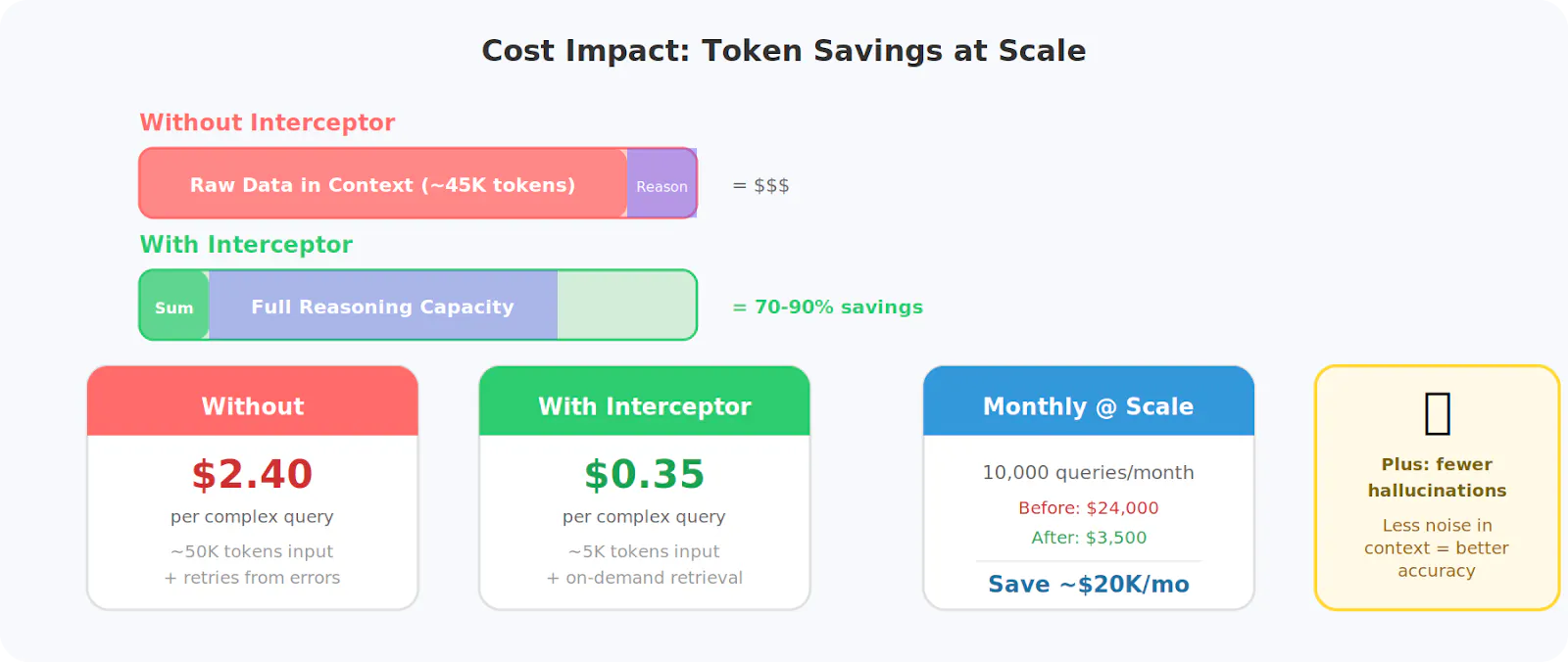
Figure 1: Cost impact of the interceptor pattern at scale
The numbers above are illustrative of typical B2B scenarios with 500+ record API responses. Actual savings depend on your specific data volumes, query patterns, and LLM pricing. The key insight is structural: the interceptor converts token cost from a linear function of data volume into a near-constant per-query cost, regardless of how much data the underlying API returns.
Total Cost of Ownership
Cost Factor
Without Interceptor
With Interceptor
LLM Token Cost (monthly)
$15K-25K (high token waste)
$2K-5K (optimised context)
Error-Related Retries
15-30% of queries retry
<5% retry rate
Infrastructure (Redis/Memory)
$0
$50-200/month
Development Effort
N/A
2-4 weeks initial build
Incident Risk (wrong writes)
High — no safety gate
Low — confirmation gating
Net Monthly Savings
Baseline
$10K-20K+ at moderate scale
ROI timeline: The interceptor typically recovers its development cost within a short time of production deployment through token savings alone, before accounting for reduced error rates and incident prevention.
Architecture Overview
What is an Interceptor?
An Interceptor is a middleware layer that sits between an AI agent and the external tools (APIs, services, databases) the agent invokes. It intercepts every tool call on the way in (before the tool executes) and every tool response on the way out (before the response reaches the agent), enabling centralised control over the agent-to-tool communication channel.
The interceptor does not modify the agent's reasoning or decision-making. It operates purely at the tool I/O boundary, making it agent-framework-agnostic. It works with any orchestration framework that supports tool calling, regardless of whether the tools are registered via function-calling schemas or discovered through MCP. From the agent's perspective, it is still calling tools as normal. It is unaware of the interceptor layer.
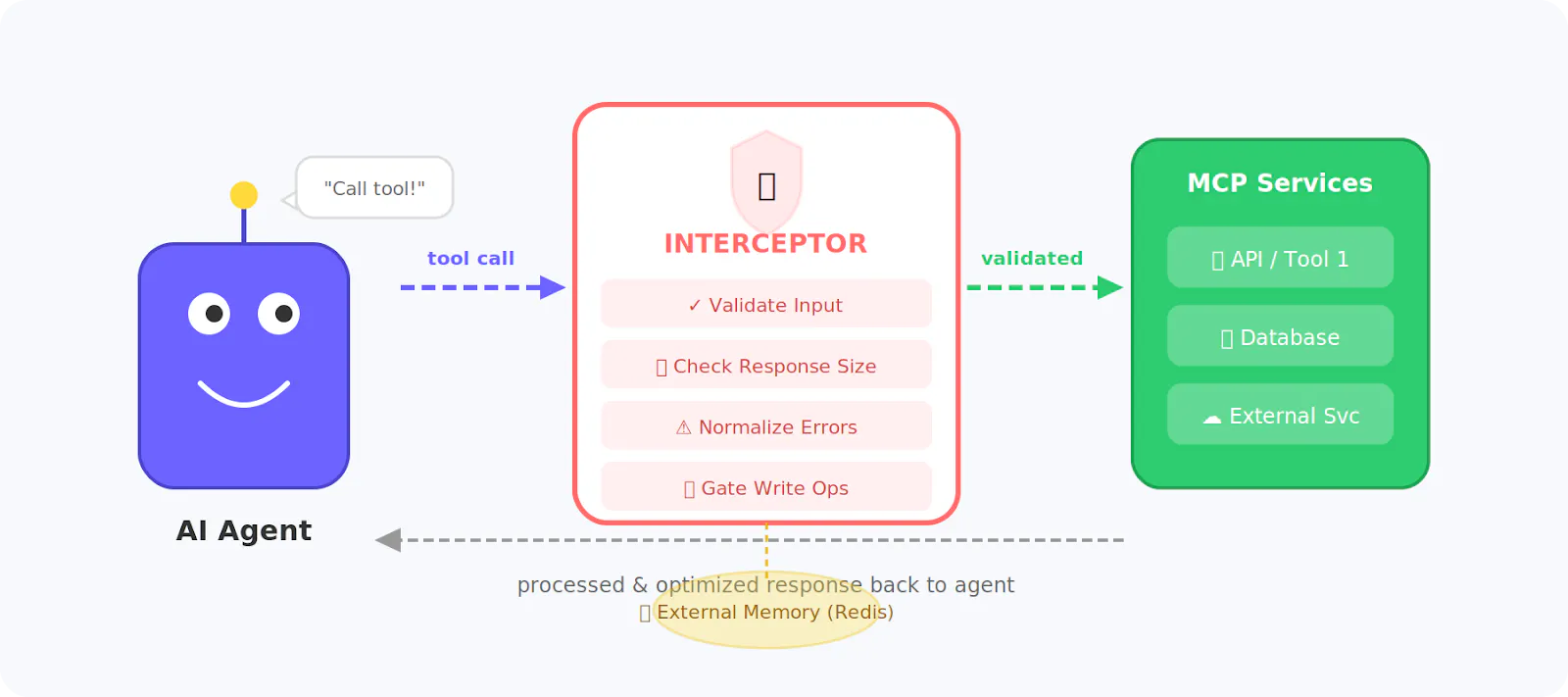
Figure 2: The interceptor sits between the AI agent and MCP services as a transparent middleware
The interceptor wraps each tool's execution function so that every invocation transparently passes through the interceptor's input and output hooks. By controlling the token going into the context window and introducing a gate in front of critical actions (i.e., upsert), the interceptor pattern introduces viable solutions to enhance agent performance, add a safety layer, and reduce LLM cost.
Benefits of the Interceptor Pattern
Capability
What It Does
How It Works (Hook)
Context Window Optimisation
Large API responses are stored in external memory rather than dumped into the agent's context. The agent receives only a summary and a memory reference, and can fetch specific fields on-demand via an internal query tool. Dramatically reduces token consumption.
mcp_output detects oversized responses, routes data to external memory, and returns a compact summary with a memory reference path to the agent.
Input Validation
All action tool inputs are validated against strict schemas before reaching downstream APIs. Invalid inputs are rejected with structured error messages guiding the agent to self-correct. Malformed inputs never leave the system.
validate_action_tool_input checks inputs against the tool's schema pre-execution. Invalid calls are bounced back with correction guidance.
Error Normalisation
Raw API errors (400, 404, 500, 503, etc.) are translated into a consistent structured format with an error message, suggested solution, and next-step instructions. The agent always receives actionable recovery guidance instead of raw HTTP errors.
mcp_output parses every response, detects error status codes, and maps them to a structured format with AgentNextStepInstructions.
Confirmation Gating
Write/action tools are intercepted before execution. The input is validated and saved to memory, but execution is deferred until explicit user confirmation. Human-in-the-loop safety without modifying the agent's planning logic.
validate_action_tool_input validates, mcp_input saves to memory and raises a confirmation exception. Execution only proceeds from memory after user approval.
Observability and Tracking
Every tool invocation is recorded with metadata and tags, providing a complete audit trail for debugging, analytics, and compliance. Enables downstream routing decisions based on what tools have been called.
mcp_input logs every call with name, tags, and metadata. Entity IDs are extracted by mcp_output and accumulated across the session for cross-referencing.
On-Demand Field Retrieval
When large datasets are stored in memory, the agent can query specific fields rather than loading full records into the context window. Keeps token usage minimal while preserving access to the complete dataset.
validate_internal_tool_call ensures the agent has called at least one external tool first, then the internal memory query tool retrieves only the requested fields.
Agent-Agnostic Design
The interceptor operates at the tool execution boundary, decoupling tool I/O logic (validation, error handling, memory management) from agent reasoning and from the tools themselves. Swap agent frameworks without rewriting I/O logic.
All hooks wrap the tool's execution function at initialisation time. The agent calls tools as usual, unaware of the interceptor layer.
Context Window Optimisation
The single biggest cost and quality improvement comes from how the interceptor handles large tool responses. Instead of dumping hundreds of records into the agent's context, the interceptor stores the full dataset in external memory and returns only a compact summary to the agent.
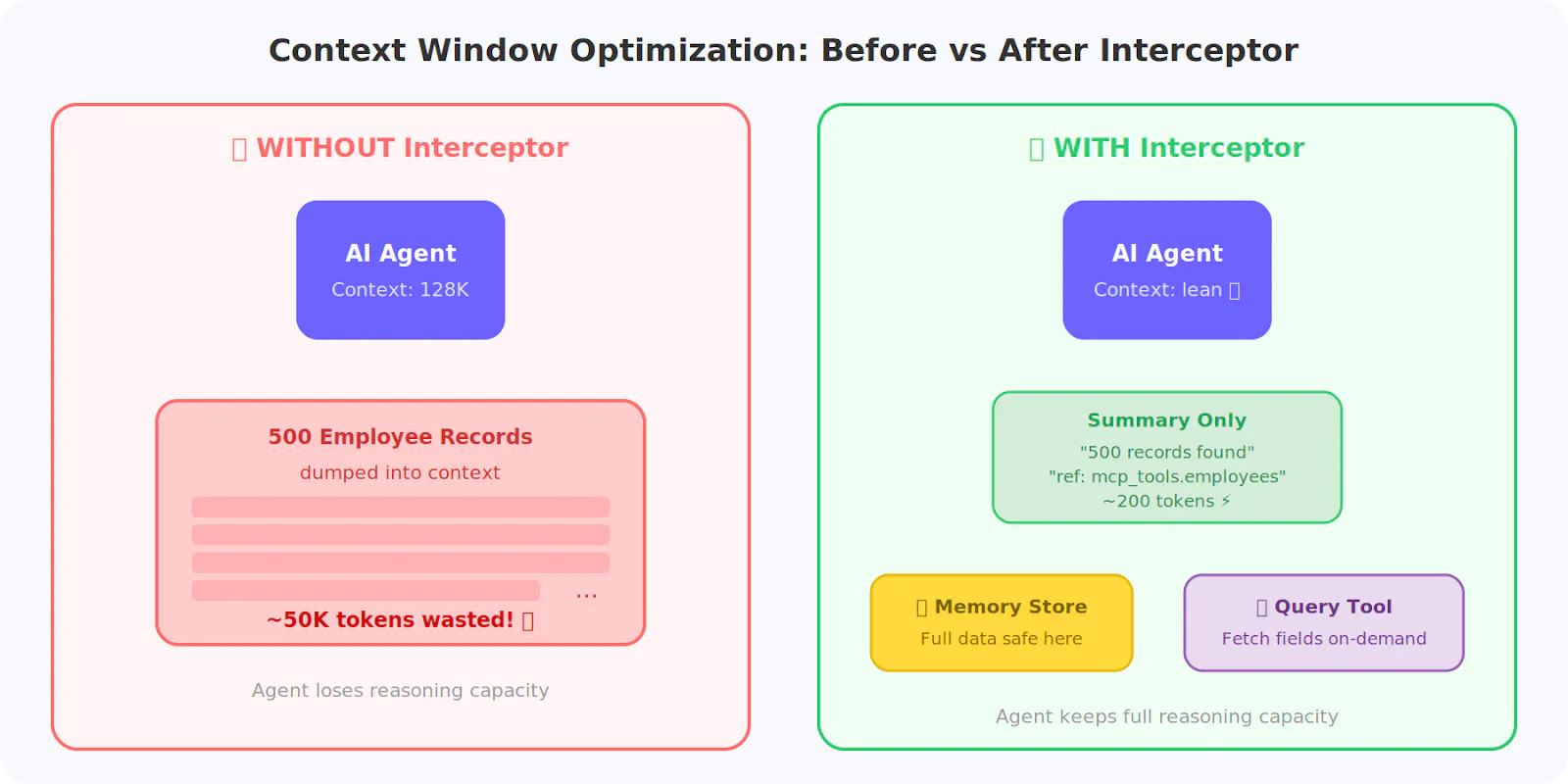
Figure 3: Context window usage — without vs with interceptor
When the agent needs specific fields from the stored data, it calls an internal memory query tool with the memory reference path and a list of fields. Only the requested fields are returned, keeping token usage minimal.
This approach has two compounding benefits: it reduces cost by cutting input tokens, and it improves quality because the agent reasons over a clean, focused context rather than being overwhelmed by irrelevant data rows.
Deterministic HITL Confirmation
For any write or mutating operation, the interceptor implements a human-in-the-loop safety mechanism. When the agent calls an action tool, the interceptor validates the input, saves it to short-term memory (separate from agent memory), and then raises a confirmation exception, pausing execution until a human approves or rejects the change. Through this, human confirmation becomes a deterministic step that always runs, providing a reduced risk of unwanted actions.
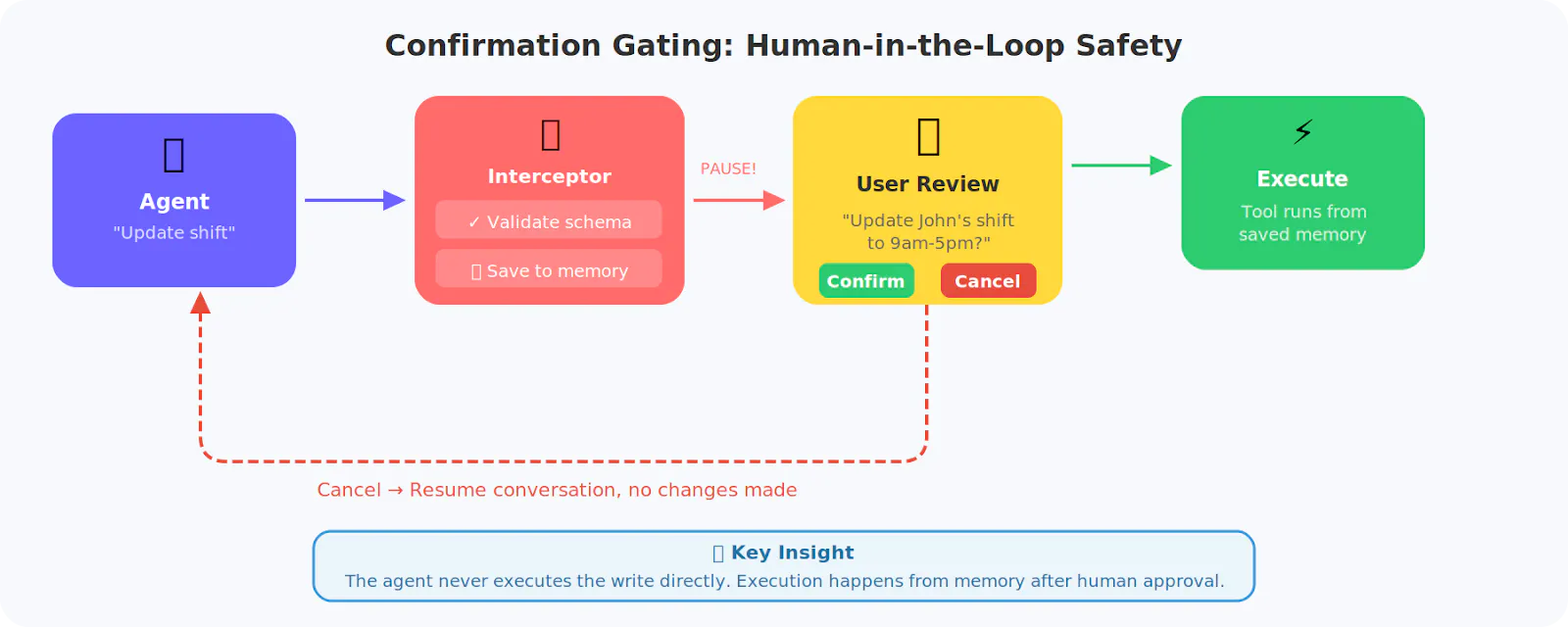
Figure 4: Confirmation gating ensures write operations require human approval
The critical design choice here is that the agent never executes the write directly. After the user confirms, the system retrieves the validated input from memory and executes the tool call independently of the agent. This means the agent cannot bypass the confirmation step, even if it is prompted to do so. However, this presents a drawback for scenarios where a sequence of multiple actions can be executed with a single Human-in-the-Loop (HITL) confirmation, or where an action tool is designed to interact with the agent for fine-tuning the input payload, asking questions before execution, or handling a recoverable failure via an agent retry (with or without a change in the tool input payload). In this case, the agent graph (see the LangChain concept of an agent graph) should resume from the last checkpoint to continue the action execution. In this scenario, relying on an action executor from short-term memory might be an overhead; therefore, execution can continue with the agent after the HITL confirmation layer. Note that this does not interfere with the Interceptor layer.
Response Size Strategy
The interceptor uses a simple threshold to decide how to handle responses. If the record count is below the threshold, the full data is returned directly to the agent's context. Counting can be based on the number of items in a payload or a Token Counter. If it exceeds the threshold, data is stored in external short-term memory, and the agent receives a summary with a memory reference path, extracted IDs, and instructions to use the memory query tool for specific fields.
Short-term Memory Layer
The memory layer provides key-value storage with TTL support via a remote service (e.g., Redis), dot-notation path access for nested data, async and sync interfaces, session and turn-scoped isolation via context variables, and sliding-window lists for keys that accumulate over conversation turns.
Error Handling
Every error status code from external tools is mapped to a structured response that includes the error message, a suggested solution for the agent, and explicit next step instructions. This gives the agent actionable recovery guidance instead of raw HTTP errors. Critical errors (500, 503) break the flow and inform the user directly. Recoverable errors (400, 404, 424) are returned to the agent with guidance for correction, enabling self-correction without human intervention.
Design Considerations
Area
Detail
Added Complexity
A new architectural layer that must be understood, maintained, and debugged. Developers must understand the interception flow to troubleshoot issues.
External Memory Dependency
Context window optimisation requires a remote key-value store (e.g., Redis). This introduces a new infrastructure dependency.
Latency Overhead
Each tool call passes through additional processing. For most use cases, this is negligible (single-digit ms), but it compounds with many sequential tool calls.
Schema Coupling
Input validation requires the interceptor to understand tool schemas. Schema changes in tools must be reflected in the validation layer.
Agent Must Learn New Tool
The on-demand memory query tool is an additional tool that the agent must learn to use correctly. Poorly prompted agents may misuse it.
When to Use an Interceptor
Use It When: Your agent calls tools that can return large or variable-size responses that risk exceeding the context window. Your agent can invoke write/action operations that should require user confirmation. You need a consistent error handling strategy across all tools. You need observability into tool usage patterns. You want input validation before reaching downstream APIs.
Skip It When: Simple chatbots with no tool calling (there is nothing to intercept). Single-tool agents where the overhead is not justified. Stateless, read-only tools with small, predictable responses. Systems where every millisecond of latency matters (though in practice, the overhead is minimal).
Offline Agent Evals: Tool Mocking
One of the most useful properties of the interceptor pattern is that it creates a natural seam for testing. Because every tool call passes through the interceptor, you can replace the real interceptor with a mocked version that returns pre-defined responses, and the agent never knows the difference.
This turns full agent evaluations into deterministic integration tests that run without touching any database, external API, or production service.
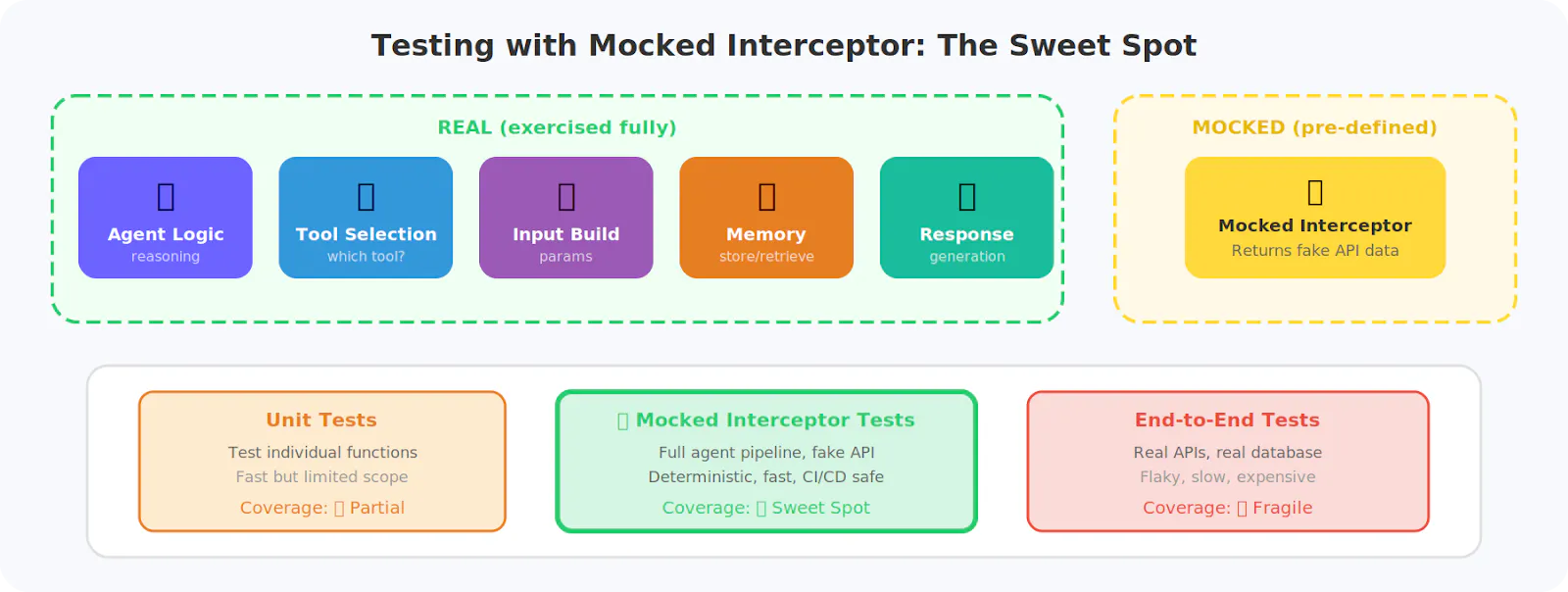
Figure 5: The mocked interceptor exercises the full agent pipeline with fake API responses
What Gets Tested: The mocked interceptor keeps everything real: the agent's reasoning, tool selection, input construction, output parsing, memory management, and response generation all execute as they would in production. The only fake thing is the API call itself. This means you test the agent's actual reasoning pipeline end-to-end without requiring a running API server, database, or third-party service.
The Testing Sweet Spot: Compared to unit tests, you get more realistic coverage by testing the agent's actual reasoning, tool selection, and input construction rather than isolated functions. Compared to end-to-end tests, you get more reliable results because the data is deterministic, with no flaky external dependencies and no database cleanup required. The cost profile is also better: no API call costs, no infrastructure provisioning, and no test data management overhead. The only real cost is LLM inference time for the agent itself.
Tests run as standard CI/CD pipeline steps with configurable markers for fast metrics (no LLM required) and expensive metrics (LLM-judged scores). This enables teams to gate deployments on agent quality without requiring a staging environment.
Implementation Guidance
Minimal Implementation Steps
Define the Interceptor class with mcp_input and mcp_output methods
Wrap each tool's execution function so calls pass through the interceptor
Implement a memory manager for storing large responses (can start with an in-memory dict, graduate to Redis)
Create an internal query tool that agents can use to retrieve fields from stored data
Add input validation for write/action tools
Add error normalisation with structured error responses
Design Principles
Transparency: The agent should not need special logic to work with the interceptor. Tool wrapping happens at initialisation time.
Fail-safe: If the interceptor itself fails, the error should be clearly surfaced. Never silently swallow errors.
Structured communication: All interceptor-to-agent communication uses a consistent JSON structure with Success, StatusCode, Errors, SuggestedSolution, and AgentNextStepInstructions.
Minimal use of context: The primary goal is to keep the agent's context window lean. Always prefer summaries + on-demand access over dumping full datasets.
Conclusion
The interceptor pattern addresses a gap that appears in an AI agent system that interacts with external tools: the lack of a structured control layer between the agent's reasoning and the tools it invokes. Without that layer, teams end up building ad-hoc solutions for validation, error handling, context management, and audit logging, scattered across different parts of the codebase and difficult to maintain.
For engineering teams, the pattern provides a clean separation of concerns and a natural testing seam. For product managers, it enables enterprise-grade features like confirmation dialogues and graceful error recovery. For business leaders, it delivers measurable cost savings and the safety guarantees required for regulated environments.
Whether or not you adopt this exact architecture, the underlying principle holds. If your AI agent calls external tools, the boundary between agent reasoning and tool execution deserves deliberate design attention. That boundary is likely where cost, quality, and safety are won or lost.
This article describes a generic architectural pattern. Adapt the implementation details (memory backend, schema validation approach, error codes) to your specific technology stack and requirements. The Interceptor pattern was recently introduced in a few frameworks with other names, but with similar concepts and purposes (middleware in LangChain V1, or Hooks in CrewAI)