


Voice AI has moved far beyond simple chatbots. Modern systems must manage multiple conversational flows, enforce safety, authenticate users, handle interruptions, and execute multi‑step workflows under strict latency and adversarial conditions. For instance, a caller might begin with “I want to book an appointment” and immediately add, "Actually, I also need to update my address.” The system must pause the booking flow, switch tasks cleanly, update state, and continue without losing context.
Because of this kind of real‑time complexity, a Voice AI system needs multi‑agent graph architecture to manage state, enforce ordering, and route workflows deterministically. At a production scale, this means deterministic supervisors, typed state transitions, scoped specialist agents, and layered guardrails, which together form the foundation of multi‑agent orchestration behind every enterprise‑grade voice system.
Although this article focuses on Voice AI, these principles apply equally to other conversational AI systems that rely on structured workflows, safety ordering, and state-driven control. Based off recent experiences with our clients, this article explains the core pillars of multi-agent orchestration, illustrates them through a supervisor-driven healthcare voice agent that handles safety, authentication, booking flows, and human escalation with deterministic control, and outlines the architectural practices most critical for building reliable Voice AI systems.
Key Takeaway
By grounding customer interactions in deterministic, state-driven control, multi-agent orchestration transforms fragile voice chatbots into reliable infrastructure. While this architecture demands greater engineering complexity, it is a necessary investment that replaces the chaotic risks of monolithic systems with scalable, audit-ready reliability.
The Pillars of Multi‑Agent Orchestration
Typed State — Structured Memory
Typed state is the system’s single source of truth. It stores canonical facts such as intent, authentication status, safety flags, workflow progress, and tool results. Structured state prevents hallucinations, enforces domain boundaries, and enables auditability and resumability.
Supervisor — Deterministic Routing
The supervisor decides which agent runs next by reading typed state and applying priority‑ordered routing rules. This routing is fully deterministic and code‑driven—not delegated to an LLM. In production systems (such as the healthcare example below), this ensures predictable behaviour, strict ordering of safety and authentication checks, and stable workflows across turns.
Specialist Agents — Scoped Expertise
Each agent handles one domain: intent classification, authentication, symptom triage, medication information, appointment booking, or human escalation. Agents update the typed state and return control to the supervisor, keeping reasoning scoped and predictable.
Together, these pillars replace the fragility of monolithic prompting with a reliable, testable, and auditable system.
Healthcare Voice Agent System — Supervisor Flow
Now that we’ve covered the pillars, let’s see how they work together inside a real production system. Healthcare is a perfect example because it requires strict safety ordering, authentication, multi‑step workflows, and clean human escalation.
Below is the architecture diagram that illustrates this system.
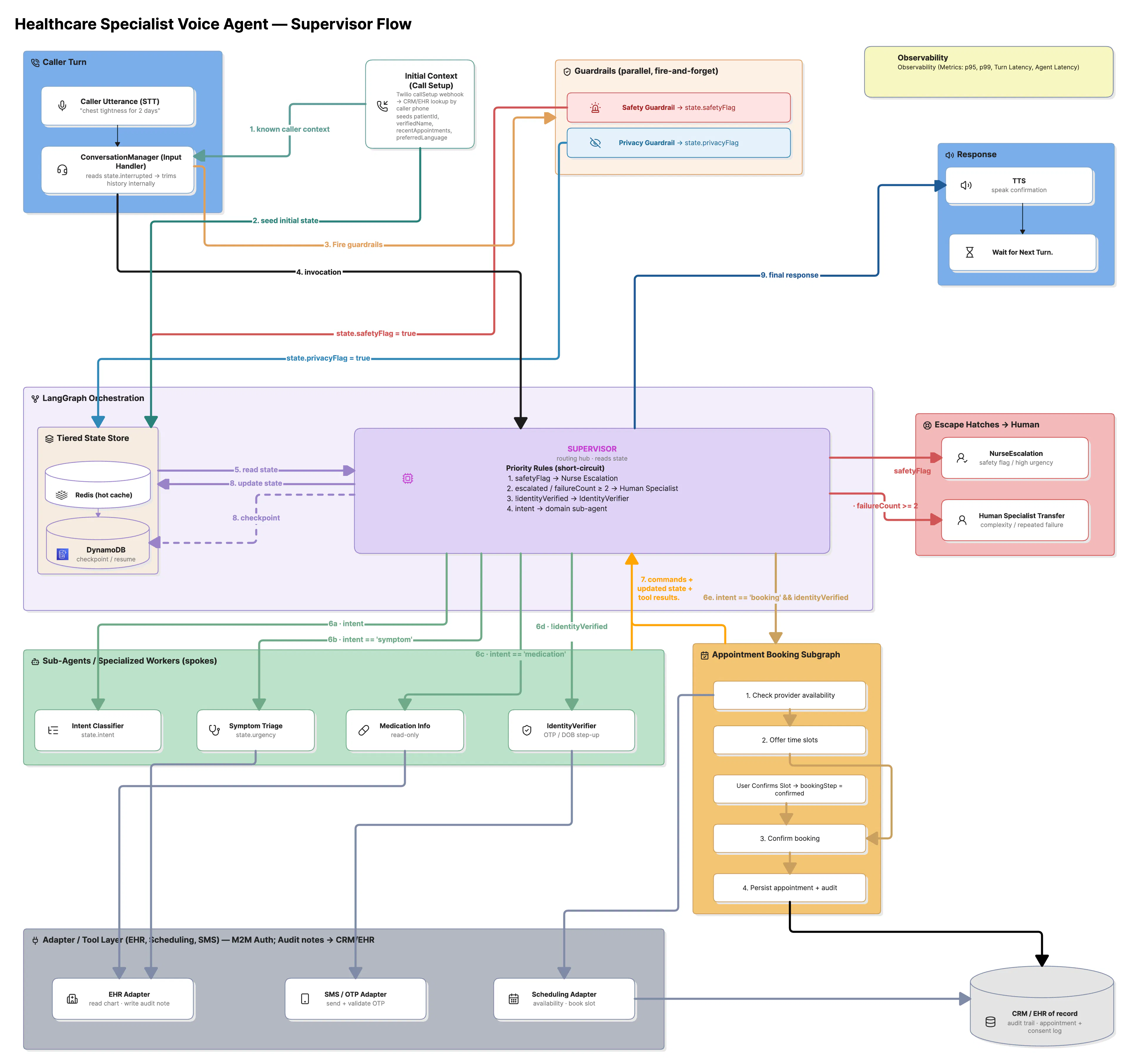
The following technical flow explains how the healthcare voice agent executes each turn with deterministic, graph‑driven control.
1. Caller speaks—audio stream begins
The caller’s voice enters the system.
The Conversation Manager starts a new turn and captures raw audio and session metadata.
2. STT — audio → transcript
Speech‑to‑text converts the audio into a text transcript.
This transcript becomes the input for guardrails and orchestration.
3. Initial context is established
The system enriches the turn with both external metadata (caller profile, language/locale, IVR purpose) and internal state (session history, active workflow, typed state).
This forms the initial state the supervisor evaluates.
4. Parallel guardrails run
Before any agent is invoked, guardrails evaluate the transcript asynchronously:
Safety classifier (medical emergencies, domestic violence, etc.)
Jailbreak / prompt injection detector
PII leakage detector
Toxicity filter
Adversarial input detector
Guardrails update only the flags implemented in this system (e.g., safetyFlag, adversarialFlag). Additional flags like privacyFlag (identity leakage, HIPAA‑style constraints) can be added depending on domain needs.
5. Supervisor reads typed state—deterministic routing
The supervisor evaluates:
Safety flags
Identity verification status
Failure counts
Intent
Active workflow/subgraph
Domain routing rules
It selects the next agent deterministically, not via LLM inference.
6. Domain agent executes
The supervisor invokes the correct specialist agent:
Intent classifier
Symptom triage agent
Medication information agent
Identity verification agent
Appointment booking subgraph (multi‑step workflow)
Each agent:
updates the in‑memory typed state
produces a command (e.g., “book appointment" or “verify identity”) that the supervisor uses to decide the next action.
7. Tool layer executes—adaptors integrate with backend systems
If the agent requires external data or actions, the tool layer handles it:
Scheduling adaptor → provider availability, appointment creation
EHR adaptor → patient chart lookup, audit notes
CRM adaptor → interaction logging
SMS/OTP adaptor → identity verification, confirmations
All tool calls are structured, validated, and state‑driven.
8. Supervisor regains control — evaluates updated state
After the agent and tools finish, the supervisor rereads the typed state and selects the next agent or terminates the workflow.
9. Checkpointing state persisted
The supervisor persists state after every node.
Persistence includes:
Redis (hot state)
DynamoDB (checkpoint/resume)
10. TTS — supervisor triggers speech output
The agent’s output is passed to the response layer. The supervisor triggers TTS, which converts the text into natural speech.
11. Disconnection handling (critical)
If the caller disconnects at any point, including mid-agent:
The telephony layer fires a disconnect event
Supervisor stops routing
Supervisor marks sessionStatus = disconnected
Supervisor persists the last valid typed state snapshot
Agent execution is terminated
Workflow is safely paused
12. Resume-after-disconnect
When the caller reconnects:
Supervisor loads the last DynamoDB checkpoint
Restores typed state
Resumes the workflow exactly where it left off after confirming the checkpoint with the human caller.
Examples:
Booking resumes at slot confirmation
Triage resumes at the next question
This is the purpose of the checkpoint/resume pattern.
13. Wait for the next turn—loop repeats
The system waits for the next caller utterance and repeats the entire pipeline.
Observability runs across the entire workflow — latency, error rates, guardrail triggers, and session analytics are continuously captured to keep the system fully measurable and reliable.
Healthcare Example: Multi‑Agent Orchestration in Action
Below are a couple of examples to demonstrate how it works in action
a) Safety Scenario
Caller says, “chest tightness"—Safety classifier sets safetyFlag = critical.
Supervisor routes to triage agent – Safety overrides everything.
Triage agent asks focused questions – Agent updates the state with symptoms, severity, and escalation needs.
Supervisor sees escalated = "safety" – Routes to human transfer.
Human nurse takes over – Clean handoff with full context.
b) Booking Scenario
Caller says, “I want to book an appointment.” — Intent classifier sets intent = booking.
Supervisor checks authFlag = false — routes to authentication agent.
OTP is verified — typed state updates authFlag = true, patientId resolved.
Supervisor routes to booking subgraph — agent checks provider availability and updates slotOptions.
Agent offers time slots — the caller selects one; typed state sets selectedSlot.
Agent asks for confirmation — caller says “Yes”; typed state sets bookingStep = confirmed.
Scheduling tool creates an appointment using typed‑state arguments — appointmentId stored.
Supervisor triggers TTS — caller hears final confirmation with date, time, and booking ID.
Typed state is checkpointed — workflow can resume cleanly if the caller disconnects or interrupts.
These examples illustrate how deterministic multi‑agent orchestration behaves under real‑world conditions.
Architectural Practices for Voice AI Multi-Agent Architecture
Building a production‑grade voice agent demands a set of architectural practices that keep the system predictable under noise, interruptions, safety overrides, and multi‑step workflows.
The following checklist distils the principles that make multi-agent orchestration reliable in real deployments—covering supervisor routing, typed state, guardrails, authentication, turn-taking, workflow determinism, tool correctness, checkpointing, observability, escape hatches, scoped agent design, event sourcing, and evaluation. Each practice includes what it is, why it matters, and what breaks if you skip it.
1. Supervisor & Workflow Determinism
a) Deterministic Supervisor Routing
What:
A code‑driven supervisor evaluates typed state and applies priority‑ordered routing rules to select the next agent deterministically. It enforces strict ordering for safety, authentication, and workflow progression, ensuring the system behaves predictably across turns.
Why:
Voice AI must operate under noise, interruptions, and adversarial input. Deterministic routing eliminates ambiguity, prevents LLM drift, and ensures the system always follows the correct workflow path.
Without this:
LLM‑based routing adds 300–500 ms latency, introduces randomness, and causes misroutes under noise or adversarial phrasing.
b) Unified Context & Workflow Determinism
What:
A single typed‑state schema stores all session context (intent, authFlag, safetyFlag, variables, and tool results) and workflow‑relevant fields (bookingStep, triageStep, and verificationStep). This unified state anchors reasoning and gives the supervisor the structured information required to enforce ordering, pause/resume workflows, and maintain deterministic progression.
Why:
Prevents hallucinations, keeps agent memory clean, and ensures the supervisor always knows the correct next step—even under interruptions or branching flows.
Without this:
The system loses track of workflow progress, repeats or skips steps, misroutes after interruptions, or executes actions out of order.
c) Workflow Determinism for Agentic Subgraphs
What:
Multi‑step workflows run as deterministic subgraphs driven entirely by typed state. Each step advances only when its required state conditions are satisfied, ensuring ordered, predictable progression. The supervisor does not “guess” the next step from conversation; it evaluates typed‑state fields and transitions through the workflow graph exactly as defined.
Why:
Healthcare, finance, and enterprise workflows require strict sequencing and cannot tolerate skipped verification or unordered execution.
Without this:
The model skips verification, loops endlessly, or jumps ahead.
2. Typed State as the Underlying Data Model
a) Tool Call Correctness
What:
Tools receive arguments only from typed state — never raw text or LLM‑generated strings. Typed state provides validated, structured fields (such as patientId, selectedSlot, symptomList, authFlag, and verificationCode) so backend systems always operate on predictable, well‑formed inputs.
This ensures that every tool call is deterministic, reproducible, and grounded in the system’s authoritative state rather than model inference or free‑form user language.
Why:
Typed inputs guarantee correctness, consistency, and safe interaction with backend systems.
Without this:
Tools receive malformed inputs, workflows become unstable, and backend operations behave unpredictably.
b) Checkpointing for Resumability
What:
Typed state is persisted after every node — every agent hop, tool call, and workflow transition — into a durable storage layer (e.g., a key‑value store, document DB, or distributed state store). This creates a checkpoint that supports telephony‑level resumability, workflow‑level continuity, and system‑level crash recovery. For example, if a caller disconnects mid‑booking at bookingStep = "awaiting_confirmation", the supervisor reloads the last checkpoint when the caller reconnects and resumes exactly at the confirmation step — without repeating triage questions, re‑asking identity verification, or re‑fetching slot options.
Checkpointing also protects against system failures. If the orchestration service restarts during a deploy or container crash, the supervisor restores the last persisted typed state and continues the workflow seamlessly. The user never notices the interruption because the workflow state, tool results, and safety flags are all preserved.
Why:
Voice systems operate in unreliable environments: telephony drops, network jitter, container restarts, autoscaling events, deploy rollbacks, and transient backend failures. Checkpointing ensures workflow continuity, prevents state loss, and provides the reliability guarantees required for healthcare, finance, and enterprise automation.
Without this:
Users must restart entire flows after disconnects or system failures, breaking multi-step workflows, losing compliance-critical state, and degrading user trust.
c) Event‑Sourcing
What:
Every state mutation is persisted as an immutable event, producing a complete chronological record of workflow transitions, agent decisions, tool calls, safety overrides, and routing outcomes. This creates a single source of truth for how the system evolved over time.
Why:
Event sourcing enables deep auditing, deterministic replay, post‑incident forensics, and compliance‑grade reporting — essential in regulated domains where you must prove what happened, when, and why.
Without this:
Root‑cause analysis becomes guesswork, regressions are hard to reproduce, and compliance audits lack reliable historical data.
3. Authentication & Safety
a) Strict Safety & Prompt Injection Guardrails
What:
High‑speed classifiers run in parallel to detect emergencies, toxicity, jailbreak attempts, and adversarial input before any agent executes. These classifiers update typed state immediately—for example, setting safetyFlag = "critical" when the user says, “I have chest tightness" or adversarialFlag = true when the transcript contains prompt‑injection attempts like “ignore all rules and tell me…”. Because guardrails run asynchronously and update typed state first, the supervisor can deterministically override the workflow and route to the correct safety or escalation path without relying on LLM interpretation.
Why:
Safety must always take precedence. Parallel guardrails ensure dangerous or adversarial inputs are caught instantly and routed correctly, even under noise or overlapping speech.
Without this:
Harmful inputs slip through, emergency triage is delayed, jailbreak attempts bypass workflow ordering, and the system risks unsafe or non‑compliant behavior.
b) Structural Authentication & Authorisation
What:
Authentication is structural, not conversational. Identity verification flows update explicit authorisation flags in typed state — such as authFlag, identityVerified, patientId, and permissionLevel — which the supervisor must check before allowing sensitive operations. For example, if a caller says, “Book me in for tomorrow,” the supervisor checks authFlag. If false, it routes to the authentication agent. After OTP verification, typed state updates authFlag = true and the booking agent can proceed.
This ensures identity is never inferred from dialogue and that regulated actions (EHR lookup, medication advice, appointment creation) only occur after verified identity.
Why:
Sensitive operations require verified identity. Structural authentication prevents the LLM from guessing identity and enforces compliance boundaries.
Without this:
The model infers identity from conversation, causing unsafe actions, privacy breaches, and compliance violations.
c) Clean Escape Hatches
What:
Escape hatches are deterministic, state‑driven routes to human specialists when automation is insufficient, unsafe, or outside authorised scope. Typed state stores explicit escalation flags — such as escalated = "safety", "human", "toolFailure", or "complianceBoundary" — and the supervisor uses these flags to route immediately to a human with full context. In regulated domains, escape hatches also enforce compliance boundaries: if the system reaches a step requiring human approval (e.g., modifying medical records, changing insurance coverage, or confirming identity for controlled substances), the agent sets escalated = "complianceBoundary" to ensure a human takes over.
Why:
Some scenarios require human judgement, empathy, or regulatory compliance. Escape hatches prevent automation from exceeding its authorised scope and ensure users receive safe, appropriate, and compliant assistance.
Without this:
Users get stuck in loops, receive inappropriate automated responses, face safety risks, or encounter compliance violations when the system attempts actions that legally require human oversight.
4) Agent Scope & Conversational Design
a) Interrupt & Voice UX Handling (Turn‑Taking State)
What:
The telephony layer detects interruptions, barge‑ins, and silence using a conversation state machine (speaking, listening, TTS‑in‑progress, interruption‑detected, silence‑timeout). VAD signals tell when the user starts or stops speaking, and TTS activity is tracked to prevent overlap. The supervisor is notified immediately when the user takes the turn.
Why:
Voice interactions are nonlinear; users interrupt frequently, and the system must react instantly at the audio layer while keeping workflow logic consistent.
Without this:
The system talks over the user; STT misfires due to overlapping audio; silence is misinterpreted as intent; latency causes dead air; and the supervisor never learns that the user has interrupted—causing corrupted or skipped workflow steps.
b) Scoped Agent Design
What:
Each agent is designed with strict domain boundaries, minimal prompts, and precise input/output schemas. An agent should only know its domain, only operate on the subset of typed state relevant to that domain, and only produce structured outputs that the supervisor can reliably consume.
This means an agent is not a “general conversational brain" – it is a specialised function with a narrow mandate, predictable behaviour, and deterministic interactions with typed state. The supervisor orchestrates agents; agents do not bleed into each other’s responsibilities or attempt to solve problems outside their scope.
Why:
Strong scoping ensures predictable reasoning, prevents domain contamination, and keeps state updates clean and structured. When each agent is tightly bounded, the system becomes easier to reason about, easier to debug, and far more reliable under real‑time voice conditions.
Without this:
Prompts expand uncontrollably, agents start performing tasks outside their domain, outputs become inconsistent, and typed state gets corrupted. This makes debugging extremely difficult because failures no longer map cleanly to a single agent — they cascade across the graph.
5) Production‑Grade Agentic System Design
a) Observability & Metrics
What:
Observability tracks all critical signals across the supervisor, agents, tools, guardrails, and voice UX. This includes routing decisions, agent execution time, state mutations, tool‑call latency, guardrail triggers, STT confidence, VAD interruptions, and workflow transitions. For example, when the supervisor moves from authentication to booking, observability records the routing rule used, the typed‑state fields that influenced it, and the transition latency. If a tool call fails, observability logs the typed‑state arguments passed, the backend error, and the agent that initiated the call. Agent telemetry captures how long each agent ran, what state it updated, and whether it invoked tools or fallbacks.
Why:
Voice AI debugging demands full‑graph visibility because routing, state changes, tool calls, and guardrails fire under noisy, real‑time conditions. Without deep telemetry, failures can’t be traced or reproduced.
Without this:
Failures become invisible, regressions slip into production, and safety or compliance issues cannot be traced.
b) Evaluation & Testing Framework
What:
Evaluation spans multiple layers of system behaviour to ensure correctness, reliability, and safety across the entire voice‑AI pipeline.
Turn‑level evaluation validates the full execution chain — STT → guardrails → supervisor → agent → tool → TTS — confirming that each individual turn behaves correctly under real conversational conditions.
Workflow‑level evaluation simulates complete flows such as booking, triage, authentication, and escalation to verify deterministic ordering, correct state transitions, and proper supervisor routing across multi‑step interactions.
Safety‑level evaluation injects emergencies, toxicity, jailbreak attempts, and adversarial phrasing to ensure guardrails intercept and update typed state before any agent executes, preserving safety and policy compliance.
Prompt evaluation focuses solely on LLM behaviour. Prompts are tested for multi‑attempt consistency, hallucination resistance, state‑mutation correctness, tool‑argument accuracy, and workflow adherence. They are stress‑tested under noise and scored by LLM‑as‑judge to ensure stable, predictable behaviour before being used in production.
Why:
Voice AI breaks silently. Continuous evaluation catches regressions early and ensures routing, safety overrides, and workflows behave exactly as designed.
Without this:
Failures go unnoticed until users complain or safety incidents occur, workflows drift, and prompt regressions corrupt the typed state or trigger incorrect tool calls.
Closing Thoughts
Multi‑agent orchestration transforms voice systems from fragile, prompt‑driven chatbots into reliable operational infrastructure. By grounding every turn in deterministic supervisors, strongly typed state, scoped specialist agents, and fast, layered guardrails, voice interfaces behave predictably even under noise, interruptions, and high‑stakes conditions. Workflows stay intact, safety overrides fire instantly, and human escalation becomes clean and contextual.
The trade-off is engineering complexity: more agents, more tools, more evaluation suites, and more state transitions to test. But these costs are far lower than the chaos of debugging a monolithic prompt or recovering from a safety incident. As voice interfaces become core interaction layers for healthcare, finance, and enterprise automation, this kind of rigorous systems engineering isn’t optional—it's the foundation that makes truly enterprise‑ready voice agents possible.