


The Strategic Case
There's a pattern I keep seeing across organisations moving into AI agents. Teams build a proof of concept, it impresses the right people, and suddenly there's a mandate to scale. The prototype that ran fine on a developer's laptop, with hardcoded credentials, no tracing, and a direct model API call, is now expected to handle production traffic, serve regulated business processes, and operate under a cloud spend budget.
That's not a technology problem. That's a foundations problem.
Building an AI agent is now remarkably easy. Building an enterprise AI agent platform, one that can securely onboard dozens of agents, give you complete visibility into what they're doing, integrate with your existing systems without sprawl, guarantee safe and compliant model behaviour, and give your finance team something coherent to look at in Cost Explorer, is an entirely different undertaking.
This post is for technology leaders and architects evaluating where to start. It makes the case for investing in platform foundations before use cases, names the nine concerns that define enterprise readiness, and explains how to sequence the work. Parts 2 and 3 go into the implementation detail.
The Gap Nobody Talks About
The AI agent demos you see at conferences are designed to be impressive in ten minutes. What they don't show is the four to six weeks of platform engineering that typically precedes any meaningful enterprise deployment: the authentication plumbing, the observability instrumentation, the integration scaffolding, the policy enforcement layer, the cost attribution machinery.
Every team building agents from scratch reinvents this work. And every team that skips it pays for it later, usually at the worst possible time: a production incident with no trace data, a surprise $40K cloud bill with no way to attribute it, an agent that called an API it was never supposed to touch, or an audit request that the platform fundamentally cannot answer.
The organisations that recognise this as a platform problem, rather than a feature problem, are the ones building durable capability. The rest are building a portfolio of bespoke agents that will eventually need to be rearchitected under pressure.
What "Enterprise Ready" Actually Requires
Before reaching for tooling, it's worth naming the specific platform concerns that separate enterprise-grade agent deployments from everything else.
A managed execution environment: running agents in production is not the same as running a prototype. You need managed compute that handles the agent invocation lifecycle, deployment within a private network, and configurable authentication controls, without every agent team building and maintaining their own infrastructure layer. The execution environment is the prerequisite everything else runs on.
Secure, attributable identity: every agent action must be tied to an authenticated identity. Not just "the service account ran this," but which specific agent, invoked by which user or system, using which credential. Without this, you cannot do access control, you cannot do audit, and you cannot do incident response.
A governed integration layer: agents need to call things. Internal APIs, Lambda functions, third-party services, MCP servers. Done naively, each of these becomes a bespoke networking and authentication problem that multiplies with every new agent. Done well, they're all mediated through a consistent gateway that enforces authentication, provides a single point of audit, and decouples agent development from the services they consume.
Deterministic behavioural controls: this is the one most teams discover too late. LLMs are probabilistic. An agent that behaves correctly 99% of the time will, at scale, behave incorrectly many times a day. You need enforcement mechanisms that operate outside the model, independent of the prompt and the agent code, that can deterministically block actions the agent should never take, regardless of how it was instructed.
Safe, compliant model outputs: regulated industries have explicit requirements around what a model can and cannot say. But even outside regulation, every enterprise has content policies, data handling obligations, and brand considerations that need to apply consistently to every model invocation. This cannot be solved by prompt engineering alone.
End-to-end observability: distributed tracing, structured logs, and performance metrics that cover the full request path: user input → model inference → tool calls → responses. Not a separate AI console. Something that plugs into your existing monitoring estate.
Managed, governed memory: persistent context across sessions is what makes agents genuinely useful. But unmanaged memory is a data governance problem. You need control over what's stored, retention periods, and scope boundaries: by agent, by user, by session.
Agent discoverability and reuse: at enterprise scale, you need to know what agents exist across the organisation, who owns them, and whether a capability you need has already been built. Without a governed catalogue, teams build the same capabilities independently, governance becomes harder to enforce, and the organisational investment in agents is difficult to track or build on.
Cost governance from day one: model inference spend compounds quickly and silently. Without a tagging strategy and budget guardrails established before agents go live, the first signal you get is a billing alert that's already too late to act on.
AWS Bedrock AgentCore: A Suite of Platform Primitives
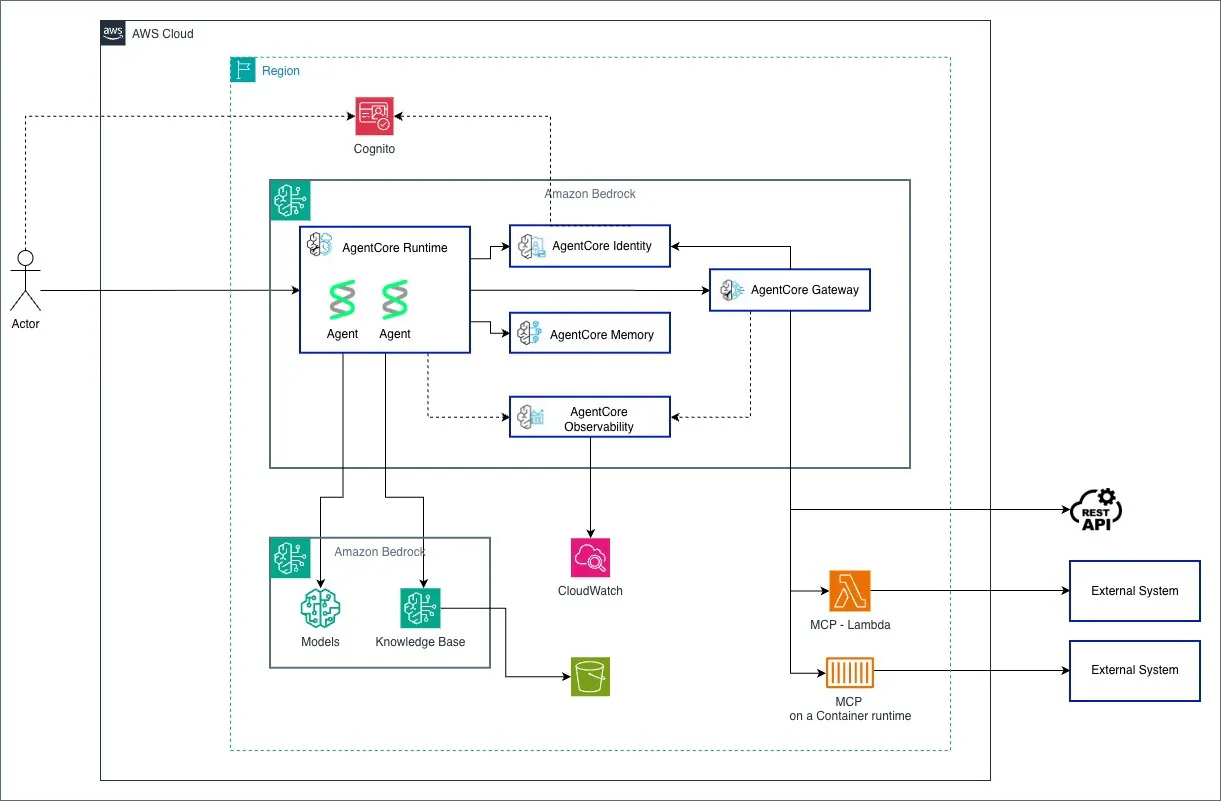
AWS Bedrock AgentCore is best understood not as a single product but as a suite of platform primitives, each one engineered to address a specific foundation concern. Parts 2 and 3 of this series cover each component in full implementation detail. At a glance:
Component
Foundation it addresses
Runtime
Managed execution environment for containerised agents, handling hosting, VPC networking, and inbound authentication
Identity
Integration with your existing identity provider so agents authenticate through infrastructure you already govern
Gateway
A managed integration layer between agents and everything they call, with centralised authentication, logging, and protocol translation
Policy
Deterministic access controls that intercept every tool call before it executes, operating outside the model and agent code
Guardrails
Content and data controls at the model inference layer, applied to inputs before the model is invoked and to outputs before they reach users
Memory
Managed context persistence scoped by agent, user, and session, with governance decisions made at the platform level
Observability
Distributed tracing through AWS X-Ray and OpenTelemetry covering the full request path, integrated with CloudWatch
Registry
A governed catalogue for discovering, publishing, and managing agents and tools across the organisation (currently in public preview)
Cost governance sits across this suite through Application Inference Profiles and a Central AI Account pattern, giving you attributable, governable model spend from day one. The full implementation detail is in Part 3.
A managed service, not a build-your-own framework
The first thing worth understanding about AgentCore is what it is not. It is not a reference architecture, a set of code templates, or an open-source framework your team deploys and operates. It is a managed service. AWS operates the infrastructure. Your teams focus on agent logic and business outcomes, not on running and maintaining the platform layer beneath them.
This matters for the investment decision. Building equivalent foundations in-house means owning the operational burden indefinitely: patching, scaling, monitoring, and updating each component as the AI landscape evolves. That engineering time does not contribute to agent capability. It contributes to keeping the lights on. AgentCore shifts that burden to AWS.
Built on the AWS estate you already govern
AgentCore does not require a separate governance model alongside your existing AWS infrastructure. Each component integrates directly with services your organisation already operates. Observability flows into CloudWatch and AWS X-Ray alongside your existing operational dashboards. Access controls are expressed in IAM policies. Network isolation runs within your existing VPC configuration. Audit trails land in AWS CloudTrail. Cost attribution feeds into AWS Cost Explorer and AWS Budgets. The Registry's publication workflow integrates with Amazon EventBridge for approval notifications.
For organisations with established AWS governance — account structures, Service Control Policies, tagging standards, and compliance controls — AgentCore extends that governance to cover AI agents rather than requiring a parallel regime to be built and maintained separately.
Framework agnostic, model flexible
AgentCore works with the agent frameworks your teams are already using or evaluating: LangChain, LangGraph, Amazon Strands, and others. The platform investment is not a bet on a specific development framework. Teams can use their preferred tooling and still benefit from the same centralised governance, observability, and cost controls.
At the model layer, Amazon Bedrock provides access to foundation models from Anthropic (Claude), Meta (Llama), Mistral, Amazon (Titan, Nova), and others through a single API. Switching between models, or running different agents on different models, does not require changes to the platform layer. Application Inference Profiles govern which agents can access which models regardless of which model is in use — giving you model governance without coupling the platform to a single provider.
Modular adoption, incremental commitment
The eight components can be adopted independently and incrementally. An organisation beginning its first enterprise agent deployment does not need to configure the Registry or implement Policy enforcement on day one. Starting with Runtime, Identity, and Gateway — the infrastructure layer covered in Part 2 — gives a team a governed foundation for the first use case without requiring the full suite to be in place from the outset.
This modularity de-risks the platform investment. You adopt what you need when you need it, and each component you add extends the governance and observability of what is already running rather than requiring a re-architecture of what came before.
The Case for Investing in Foundations Before Use Cases
Here's the argument I'd make to any senior technology leader evaluating the sequencing of this investment:
Platform foundations are largely a fixed cost. You pay them once. The cost of not having them scales with every agent you deploy, each one accumulating its own authentication debt, its own observability gap, its own policy blind spot. By the fifth agent deployment, you're not five times more capable. You're carrying five times the technical debt.
The sequencing of this investment matters as much as the investment itself. The most common failure mode is not refusing to invest in foundations. It is deferring the architectural conversation until the first agent is already in flight. By then, the authentication model has been decided by default, the tagging strategy has been skipped, and the Gateway configuration has been shaped by what was expedient rather than what was deliberate. Retrofitting is always possible. It is never free.
The more productive framing is an MVP platform: the minimal set of foundations that needs to be in place before the first agent use case reaches production. Not every component from day one, but the decisions that are expensive to change later, made deliberately and early. In practice this means agreeing on the identity and authentication model, establishing the Gateway architecture and target patterns, putting Application Inference Profiles and the tagging strategy in place, and standing up observability before the first agent is live. These take days to weeks to get right, not months, and they do not need to block the first use case from being scoped or built in parallel.
The platform build and the first agent use case can and should run concurrently. The platform team delivers the foundation; the agent team builds against it and validates it. The first use case becomes a proving ground for the platform, not just a proof of concept for the agent.
From there, the platform extends as agents start using it. Memory governance, Registry configuration, and Policy rules do not all need to be resolved on day one. What matters is that the foundational decisions are made before they harden into defaults. The rest follows the agents.
The organisations getting foundations right now are building a compounding advantage. Their second, fifth, and twentieth agent deployment is faster and lower risk than the first. The patterns are reusable, the tooling is already in place, and the governance questions have already been answered.
AWS Bedrock AgentCore provides a coherent set of primitives for exactly this: Runtime, Identity, Gateway, Policy, Guardrails, Memory, Observability, and cost governance through Application Inference Profiles. The work is in wiring them together deliberately, understanding the constraints early, and making the architectural decisions before agents go live rather than after.
That investment has a compounding return. The alternative does too, just not the kind you want.
Part 2 of this series covers the infrastructure layer: AgentCore Runtime, Identity, and Gateway, the three components that form the connective tissue of the platform and need to be in place before anything else. Part 3 covers controls, governance, and the architectural decisions that harden into defaults: Policy, Guardrails, Memory, Observability, Registry, cost governance patterns, when to consider a model gateway, and the lessons that only surface once you are building in production.