


Written by Devang Dhameliya
Main Problem: Data that We Can't Use
In the modern enterprise, data is everywhere. It accumulates in shared network drives, cloud storage buckets, and content management systems, forming a digital landfill of untapped potential. This "dark data" - the vast and growing collection of unstructured content - is the central paradox of the digital age. Businesses are data-rich but information-poor.
This unstructured data, which comprises 80-90% of all new enterprise data, arrives as a relentless flood of PDFs, scanned images, call-center audio files, and support videos. While organisations have successfully wrangled their structured (database) data, they remain largely unable to extract value from this unstructured majority.
This is not an abstract IT problem; it is a tangible business bottleneck. It is the root cause of workflows that remain "slow, paper-heavy, and prone to errors". It manifests as "frustrating delays and manual rework" in processes that, despite being labeled "automated," still require significant human intervention. From loan processing to healthcare claims, the inability to automatically and reliably extract meaning from these files represents a massive, persistent operational drag and a significant source of missed revenue.
What "Automation" Looks Like Today?
For years, the industry's answer to the unstructured data problem has been a "Do-It-Yourself" (DIY) approach, particularly within the public cloud. Technically savvy organisations have been forced to build complex, brittle, and expensive "Rube Goldberg machines" to solve what seems like a simple task.
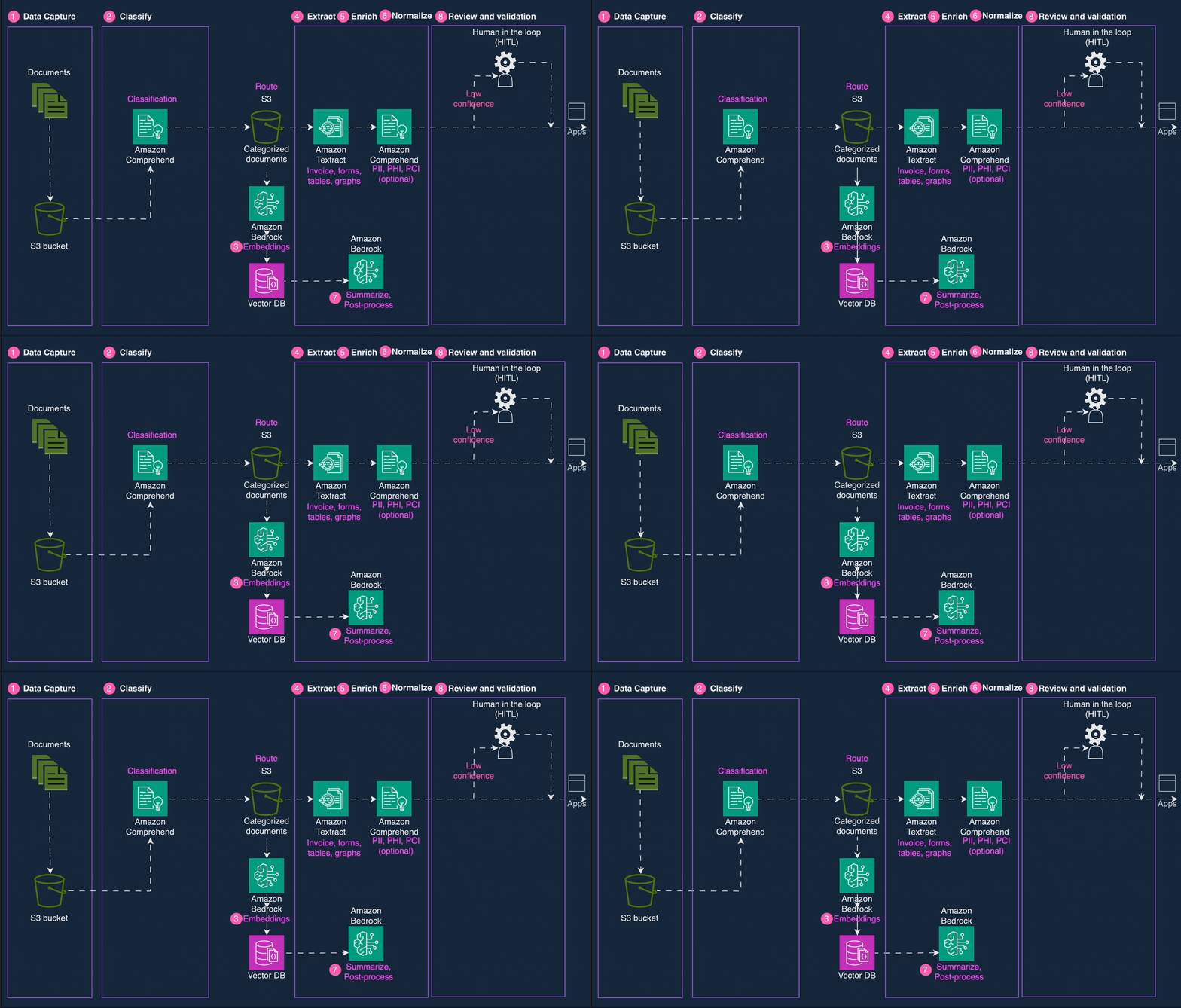
This "Traditional Workflow" is a fragile chain of disparate, single-purpose services manually stitched together with custom code. An examination of a common use case, such as loan processing, reveals the sheer complexity:
Ingestion and Splitting: A 50-page loan package PDF is uploaded to Amazon Simple Storage Service (Amazon S3). This single file, however, is not a single document. It contains a Tax Return Statement, two bank statements, a driver's license, and an application form. The first step requires an engineering team to write custom logic, likely in an AWS Lambda function, just to split this file into its constituent parts.
Classification: Now that the files are split, the system must determine what they are. This requires a second step: an API call to a service like Amazon Comprehend or a custom-trained classifier to categorise each document (Tax Return Statement, bank statement, etc.).
Extraction: Once classified, the documents are sent to an Optical Character Recognition (OCR) and data extraction service, such as Amazon Textract, to pull out key-value pairs and tables.
Normalisation: This is the hidden factory where most DIY projects fail. Textract outputs raw, unstandardised data. One date may appear as "Jan. 1, 2025," another as "02/03/25," and a currency value as "$(1,200.00)." A massive amount of "additional processing"—more custom Lambda code—is required to parse, validate, and standardise this data into a consistent format (e.g., ISO 8601 dates, float-value numbers) that a downstream system can actually ingest.
Orchestration and Error Handling: To manage this multi-step, asynchronous process, a developer must build and maintain a state machine in AWS Step Functions.
This entire "automation" is a "rule-based system" that relies on "predefined, static logic patterns". It is fundamentally brittle.
A visualisation of this traditional, complex, and high-maintenance workflow is as follows:
Amazon's New Service: Bedrock Data Automation
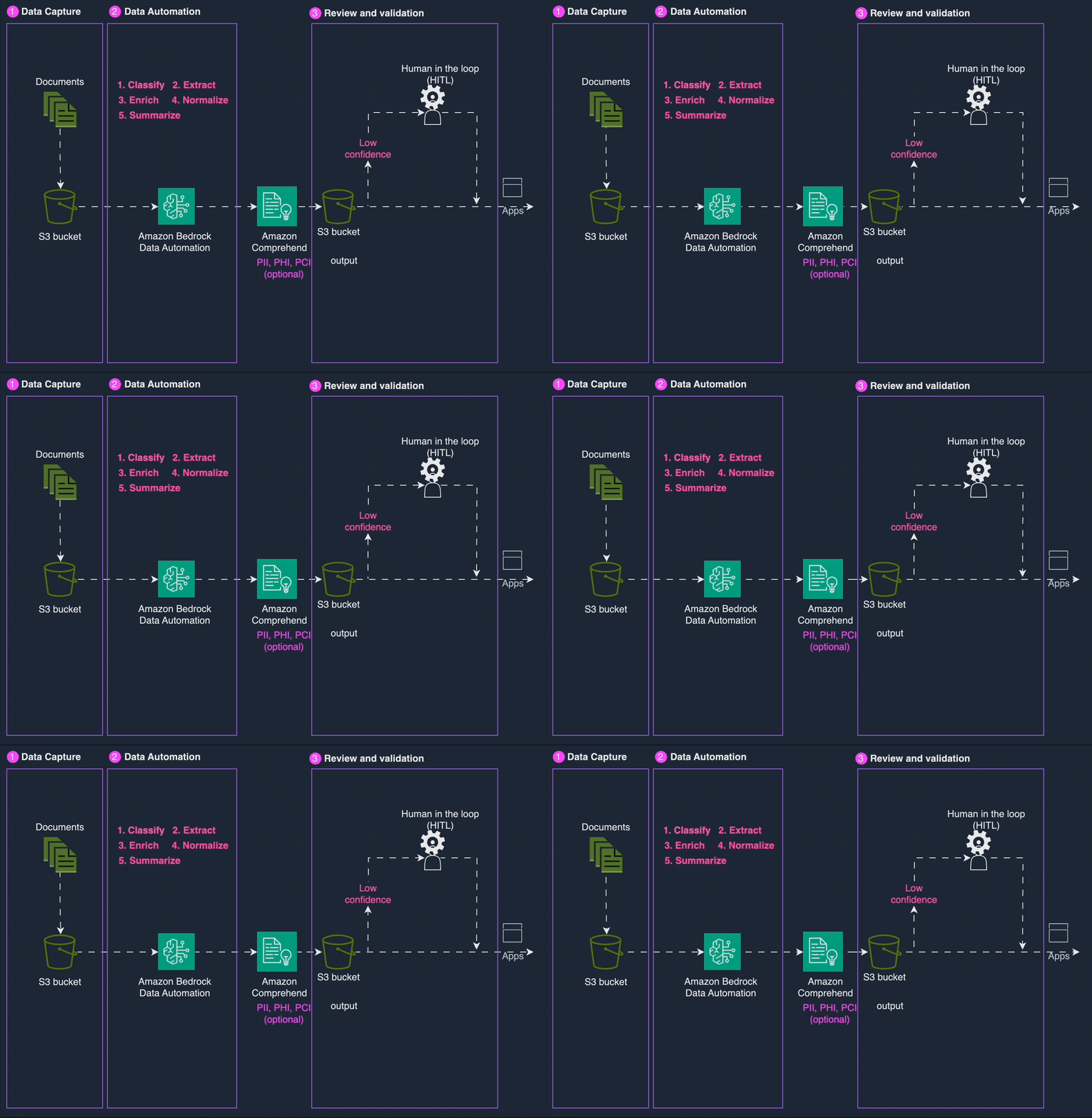
The core problem of the traditional workflow is not any single component, but the integration and orchestration itself. The value is lost in the "stitching". In response to this, Amazon Web Services has introduced Amazon Bedrock Data Automation, a fully managed feature designed to replace this entire complex chain with a single, unified API.
This service is not just another tool; it is a fundamental shift from a DIY "kit-of-parts" to a fully managed, "end-to-end" solution. It directly addresses and automates the most complex and failure-prone steps of the traditional workflow:
Automated Splitting: Where developers previously wrote custom logic, Bedrock Data Automation "automates document splitting and processing".
Single-Step Processing: Instead of separate API calls for classification and extraction, the service "classifies documents and extracts key information in a single step".
Schema-Based Normalisation: This is the most significant capability. The "last mile" nightmare of custom normalisation code is eliminated. Bedrock Data Automation "automatically standardises extracted data... based on the customer-provided output schema". Developers define their desired JSON output, and the service handles the transformation.
Built-in Validation: The service moves beyond simple extraction to include validation. It supports "automated validation rules for extracted data, supporting numeric ranges, date formats, string patterns, and cross-field checks". This ensures data quality before it enters downstream systems.
Managed Orchestration: The service "handles the orchestration and custom integration efforts", effectively replacing the need for a manually configured Step Functions state machine for this part of the workflow.
This managed approach allows for the creation of processing pipelines via "pre-built blueprints," enabling organisations to "develop and deploy solutions quickly". The result is a dramatic simplification of the data processing architecture.
A Deep Dive: Healthcare Claims Automation
Nowhere is the unstructured data problem more acute, complex, and costly than in healthcare claims processing. This domain is a "perfect storm of administrative burden". The sheer complexity is staggering: the AMA recognises approximately "68,000 diagnosis codes" and "8,000 procedure codes," with "countless permutations".
This complexity has created a system reliant on "manual effort" that is "time-consuming, error-prone, and resource-intensive". The financial consequences are severe. Provider organisations "typically lose approx. $210,000 annually due to under-billing". This revenue leakage stems from simple but costly errors: "underestimating evaluation and management (E/M) levels and missed preventive service billing". For example, one study showed that while most eligible patients receive smoking cessation services, "only about one-third of these services result in submitted claims for reimbursement".
The "Before" State: Days to Process, High Error Rates
Traditionally, a paper claim (like a CMS-1500 form) arrives at a health plan, where a data entry team manually keys the information into a core claims processing system. This process is the definition of a bottleneck: it can take "days" and is plagued by "lower data accuracy".
The "After" State: A Modernisation On-Ramp
Amazon Bedrock Data Automation (BDA) is positioned as the critical "on-ramp" to modernise this legacy process. An architecture designed for this exact purpose connects BDA with other AWS services to create a true end-to-end flow:
Ingestion: Scanned paper claims are securely uploaded to an Amazon S3 bucket.
Automation & Extraction: The S3 upload event triggers BDA, which "intelligently extract[s] structured data from the claim forms". In this single step, BDA classifies the form, extracts all patient information, diagnosis codes, and procedure codes, and validates the data against a predefined schema.
Transformation & Integration: This is the key integration. BDA outputs a clean, structured JSON file. A separate service, AWS B2B Data Interchange, monitors this output location. It automatically picks up the JSON and "transforms the extracted data to standardised 837 EDI (Electronic Data Interchange) transactions".
Delivery: These standardised, industry-accepted EDI files are then delivered to another S3 bucket, "ready for integration with the health plan’s existing claims processing system".
This architecture effectively builds a bridge from a physical, paper-based world to a modern, digital, API-driven one. It eliminates the manual data entry step entirely.
The business outcomes of this "After" architecture are transformative. This solution delivers "significant business outcomes" that directly impact the bottom line, including:
Massive Cost Reduction: "Up to 80% reduction in per-claim processing costs".
Accelerated Speed: "Reduced processing time from days to minutes," which accelerates provider reimbursement cycles.
Improved Accuracy: "Improved data accuracy with lower error rates compared to manual processing".
Advanced Fraud Detection: The structured data allows AI-powered analytics to "identify suspicious patterns" and reduce "costly fraud, waste, and abuse" without delaying legitimate claims.
Comparison & Analysis
The features and ROI metrics are compelling, but the true disruption of Amazon Bedrock Data Automation lies in its business model. The "extra analysis" of its cost structure reveals a fundamental, and far more strategic, shift in how enterprises can procure and budget for AI.
A. The Compounding Costs of DIY Automation
The "Rube Goldberg machine" described in Section 2 is not just complex to build; it is wildly expensive and unpredictable to operate. Its cost is a "death by a thousand cuts," with charges compounding at every step of the pipeline:
Orchestration Costs: The AWS Step Functions workflow (Standard) incurs a charge for every single state transition. At $0.025 per 1,000 transitions, a 7-step workflow processing one million documents would incur 7 million billable transitions, adding a small but definite cost.
Compute Costs: Every piece of custom logic (splitting, normalisation) running on AWS Lambda incurs charges for both requests and duration (GB-seconds). This is a variable compute cost that scales with data complexity.
Extraction Costs: Amazon Textract bills on a complex, per-page, tiered model. Extracting "Forms" costs $50 per 1,000 pages, while "Tables + Forms" is $65 per 1,000 pages (for the first million pages).
The "AI Tax" (Token Costs): If the workflow requires a powerful Foundation Model (FM) for summarisation or complex normalisation, it introduces the highly unpredictable cost of token-based pricing. A high-end model like Anthropic's Claude 3 Opus, available on Bedrock, costs $15 per million input tokens and $75 per million output tokens. A single complex document could be thousands of tokens, making budgeting a forecasting nightmare.
Human Capital Costs: The most significant and most hidden cost. This is the "perpetual game of catch-up". It is the fully-loaded salary of a team of senior engineers who are not innovating but are instead perpetually manually updating the rules on a brittle, essential system.
B. Comparison: Predictable, Per-Modality Pricing
Amazon Bedrock Data Automation’s pricing model is its most revolutionary feature. It abandons the complex, variable, and compounded cost structure of the DIY method.
The service "offers transparent and predictable pricing". The model is simple: "Pay according to the number of pages, quantity of images, and duration of audio and video files".
This is a strategic masterstroke. AWS has explicitly noted that "This straightforward pricing model provides easier cost calculation compared to token-based pricing model".
This shift moves the cost calculation from a technical, variable metric (tokens, GB-seconds, state transitions) to a business, fixed metric (pages, images, minutes). A hospital's Chief Financial Officer does not know how many "tokens" the organisation will consume. They do know, with high precision, how many claims (pages) they process per month.
This model de-risks AI adoption. It allows for exact budgeting. The enterprise is no longer buying a collection of volatile-priced "parts"; it is procuring a business outcome (one page processed) for a fixed price.
The table below summarises this fundamental shift in cost, risk, and value.
Cost Model Comparison: DIY vs. Managed Automation
Feature
"Old Way" (DIY Pipeline)
"New Way" (Bedrock Data Automation)
Primary Cost Driver
Compounded & Variable:
• $ per state transition (Step Functions)
• $ per request + GB-second (Lambda)
• $ per 1,000 pages (Textract)
• $ per 1,000 tokens (LLM)
Unified & Fixed:
• $ per page
• $ per image
• $ per minute of media
Cost Predictability
Low. Highly variable. Depends on document complexity, number of steps in the state machine, and LLM "chattiness."
High. Directly tied to business volume (e.g., "10,000 claims processed"). "Transparent and predictable".
Developer Overhead
Extremely High. Requires a dedicated team for ongoing maintenance, integration, and manually updating the rules.
Low to None. Fully managed service. AWS handles orchestration, model updates, and maintenance.
Time-to-Value
Weeks to Months. Complex build, test, and deployment of a multi-service architecture.
Hours to Days. "Designed for rapid deployment". Use pre-built "blueprints".
Key Risk
Brittle, "rule-based systems" that break. "Perpetual game of catch-up".
Managed service reliance (vendor lock-in).
Conclusion
The analysis concludes that the problem with unstructured data has never been a lack of "AI." It has always been a problem of plumbing. For decades, enterprises have spent the vast majority of their time, money, and engineering talent on building and maintaining the fragile plumbing required to get data from point A to point B.
Amazon Bedrock Data Automation represents a strategic shift. It is a managed service that, for a fixed, predictable fee, offers to take on the entire maintenance and orchestration burden of the plumbing.
This is not just about saving money, though the "up to 80% reduction" in processing costs is a powerful incentive.9 It is about reallocating an organisation's most valuable and scarce resource—its engineering talent—away from low-value maintenance and toward high-value innovation.
Real-world case studies in analogous industries prove the transformative power of this shift. The UK insurer Aviva, by deploying a suite of AI models to overhaul its claims domain, achieved a "23 day" reduction in liability assessment time, a "30 percent" improvement in routing accuracy, and "saved... more than £60 million" (AUD 121 million) in a single year.18 This is the "why." This is the prize for solving the plumbing problem.
This service allows businesses to stop acting like ad-hoc machine learning engineering teams and start being data-driven enterprises. It shifts the central, animating question of the IT department from "How do we process this PDF?" to "What do we do with this insight?"